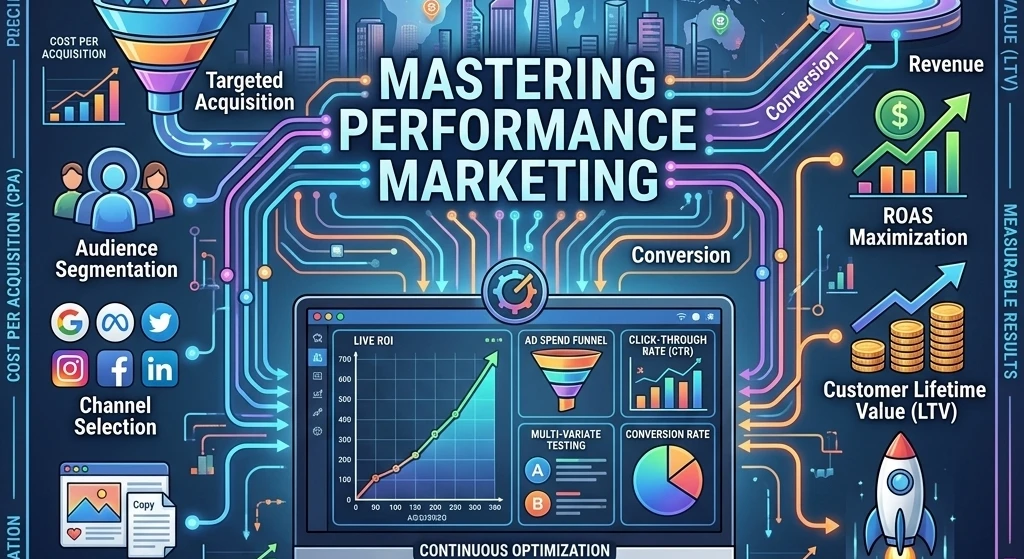
What Is Performance Marketing?
Imagine you are running your business and you need to do marketing for your products. You look into traditional marketing methods where you have to pay for the ad no matter what output you will get from this ad. But paying without looking at outcomes is not fair enough, especially for companies that are on a strict budget for marketing.
Here comes the efficient and modern way of marketing called as performance marketing. Unlike traditional marketing practices, in performance marketing we only pay for the results we get through our marketing. By adopting this smart marketing option, the advertiser will get the maximum return on the money he spent on marketing.
Performance marketing is in high demand specially because of its economic advantages to the advertising firms. As a result, people having knowledge of performance marketing are in high demand with high salary benefits. The early mover in this field will have unfair advantages like high salary and high demand in industries.
There are many entry-level roles in the field of performance marketing. If you are a student or a working professional, you can start your journey in performance marketing as a fresher with good salaries.
Skills You Will Learn in a Performance Marketing
To enter the field of performance marketing, you need to learn a few in-demand skills. These skills will help you optimise ads more efficiently and generate maximum return on marketing budget. Let’s go through the skill set that will make you a good performance marketer.
1. Marketing fundamentals:
Marketing fundamentals will give you a basic idea about the purpose and working of marketing campaigns. It also talks about concepts like product promotion, appropriate audience targeting and basic seo techniques.
2. Data analysis:
This skill helps you analyse the data and leads we are generating through marketing. You can analyse metrics like click-through rates (CTR) and cost per click (CPC).
3. Creative Ad Copywriting strategies:
Marketing is not just about right targets and showcasing features; its core lies in understanding audience behaviour and psychology about what triggers them. This skill will help you in writing a creative script that will convert the audience into customers.
4. Experimentation and testing:
As a marketer, you need to do experiments with different ads and platforms to analyse what is working best for you. Testing involves exploring this experimentation and testing the performance on the basis of multiple factors.
5. Ad platforms and social media marketing:
There are some online platforms like LinkedIn ads, Meta ads, and Google ads that show ads on social media and other online platforms to help businesses grow. This is one of the essential skills to land a job in performance marketing.
6. Server-side Tracking:
Server-side tracking in performance marketing is a method of collecting user data directly from the website's server, instead of relying on browser-based tools. It provides more accurate data, better privacy, and fewer issues caused by ad blockers or browser restrictions. This skill will help you to get more accurate data, which leads to more detailed analysis.
7. Conversion API:
The Conversion API is a tool that allows websites and apps to send user actions directly to platforms like Facebook or other marketing tools from their servers. It helps track conversions more accurately and reliably, even if browser-based tracking is blocked or limited.
8. Prompt Engineering:
Prompt Engineering involves crafting specific instructions to guide AI responses effectively. In performance marketing, it helps create targeted content, analyse data, and personalise campaigns. This improves efficiency, enhances strategies, and drives better marketing results.
These skills can be seen majorly in job descriptions of entry-level roles in performance marketing. All of these skills are in high demand, and anyone can learn these skills with a structured learning process and the right guidance.
Scope in Performance Marketing
As internet users are expanding globally, people are spending more time on the internet and social media platforms, so traditional advertising practices like posters and hoardings are on the back foot. As a result, there is rising demand for digital marketing, which is boosting demand for performance marketing also.
New business specially D2C brands, are preferring performance marketing as its reliable and more efficient way of advertising. These brands are focusing on the end user and audience they want to target; this is triggering demand for performance marketing.
However, other factors like integration of AI and automation techniques are contributing to the growth of performance marketing.
Since most of the companies are looking for optimised and efficient advertising marketing, the professionals who are experts in performance marketing will be in high demand.
Career in Performance Marketing
Performance marketing offers high paying carrier options. If you are someone who is interested in working in a creative field along with analysing data and strategy-making for marketing purposes, performance marketing may be the best suitable field for you. Performance marketing offers flexible working with a good salary and significant growth.
Types of work in this career
Performance marketing involves working with an analytical and creative mindset. As a performance marketer, you will be responsible for writing ads and analysing ad performance with different strategies and experimentation. This field involves working closely with ad budgets and marketing strategies to maximise return on investment on the advertisements.
Jobs in Performance Marketing in India
1. Marketing analyst:
Marketing analyst is someone who performs analysis on several factors like competitor analysis, customer behaviour and market trends. This analysis helps businesses optimise their marketing techniques and maximise ROI on ads.
2. Performance Marketing Manager:
Performance marketing managers focus on managing ad campaigns and maximising ROI on them. They set suitable budgets and decide favourable ad platforms for ad campaigns. They report on the ROI and reach we are getting through ad campaigns.
3. Performance marketing executive:
As a performance marketing executive, you will be responsible for setting up and optimising ads. You will analyse ad performance and track how ads are performing. This role is suitable for fresh graduates and students.
4. Digital marketing director:
A digital marketing director looks into marketing strategies, budget allocation and data-driven decisions companies are taking. This is a senior-level role in the field of performance marketing role and you need several years of experience to be in this post.
5. Paid ad specialist:
This role is suitable for a fresher who has appropriate skills related to performance marketing. Paid ad specialists are people who create and manage ads on platforms like Meta Ads and Google Ads.
All of these roles require skills and analytical thinking. These are high-paying roles in the performance marketing field. However, salaries vary with factors like experience, skills, and city.
Work Flexibility and Work from Home Opportunities
One of the biggest advantages of a career in performance marketing is the flexibility it offers. Since most of the work is done online using tools like Google Ads, Meta Ads, and Google Analytics, many companies offer work from home (WFH), hybrid, and remote job opportunities.
Performance marketers can manage advertising campaigns, analyse data, and optimise results from anywhere with a laptop and a stable internet connection. If you are looking for a career that offers flexibility, remote work opportunities, and a good work-life balance, performance marketing is an excellent choice.
Performance Marketing Salary in India
Companies pay high salaries to employees who generate high revenue for the companies through ad campaigns. And performance marketers are the ones who are actually doing this. That's why performance marketers’ salaries are rising. As a fresher in performance marketing, you can expect a salary starting from 3 LPA. Although it depends on factors like the skills you have and the location.
| Role / Level | Salary Data Point (INR) |
|---|---|
| Performance Marketing Head | ₹35,00,000 – ₹70,00,000 (LPA) |
| Performance Marketing Manager | ₹12,00,000 – ₹22,00,000 (LPA) |
| Performance Marketing Specialist | ₹3,00,000 – ₹5,00,000 (LPA) |
| Paid Media Specialist | ₹4,00,000 – ₹9,00,000 (LPA) |
| Performance Executive | ₹3,50,000 – ₹6,50,000 (LPA) |
Tools Used in Performance Marketing
To land a high-paying job in the performance marketing field your need to master several tools like Google Analytics, LinkedIn Ads, Meta Ads and Google Ads. These tools help performance marketers run paid campaigns and analyse their results.
1. Google Analytics (GA4):
Google provides a platform called Google Analytics to analyse the performance of ad campaigns. It allows performance marketers to analyse data generated from campaigns and measure the ROI.
2. LinkedIn ads:
Targeted audience is one of the significant metrics in performance marketing. When it comes to a professional audience, the tool called LinkedIn Ads offers that environment. Linkedin ads allow you to reach the targeted and professional audience through their platform, called linkedin.
3. Google Ads:
Google Ads is one of the major ad platforms, and it offers different ads such as search-based ads, video ads, YouTube ads, and display ads. This tool allows businesses to run ad campaigns across its several partner platforms like YouTube.
4. Meta ads:
Meta ads are a social media ad platform that helps businesses reach the targeted audience. Meta ad offers ad on several social media platforms like Instagram, Facebook and other partner platforms.
5. Claude:
Claude is one of the finest AI chatbot which give highly precise results. This tool is designed for highly accurate outputs and to understand complex context. Claude helps marketers to design strategies and generate engaging content.
6. Looker Studio:
Looker Studio is a data visualisation tool that helps create interactive dashboards and reports. In performance marketing, it enables real-time data analysis and tracking of campaign metrics. This improves decision-making, optimises strategies, and drives better marketing results.
7. Google Tag Manager:
Google Tag Manager is a tag management system that allows marketers to easily add, update, and manage tracking codes and scripts on their websites without modifying the code directly. In performance marketing, it streamlines the deployment of tracking pixels, conversion tags, and analytics scripts, enabling accurate data collection and measurement. This helps optimise campaigns, improve targeting, and enhance overall marketing performance.
8. Google AI Max Campaigns:
This refers to leveraging Google's AI capabilities to maximise performance in ad campaigns, often through automated bidding, targeting, and creative optimisation in Google Ads.
9. Performance Max:
A Google Ads campaign type that uses automation and AI to serve ads across all Google inventory (Search, YouTube, Display, Discover, Gmail, Maps) based on your goals, optimising for conversions and reach.
10. Merchant Centre:
A Google platform where e-commerce businesses upload product data to be used in Shopping ads, local store visits, and other shopping-related campaigns. It enables product listings to appear across Google services.
11. ChatGPT:
An AI language model developed by OpenAI used for generating human-like text, assisting in content creation, customer support, and data analysis.
12. Gemini:
Google's AI model family, designed to advance language understanding and multimodal capabilities, which helps in engaging content writing and market research.
13. Microsoft Clarity:
A free analytics tool that provides website heatmaps, session recordings, and insights into user behaviour to improve website performance and user experience.
14. Hotjar:
A behaviour analytics tool offering heatmaps, session recordings, surveys, and feedback polls to understand how visitors interact with a website and identify areas for improvement.
15. Google Ads Editor:
A downloadable application that allows users to manage and edit Google Ads campaigns offline efficiently, making bulk changes and managing large accounts more easily.
Since companies want a targeted audience and high ROI on the money they are spending on ads, people who know these skills are in high demand.
Performance Marketing vs Digital Marketing: Which is better in 2026
Both digital marketing and performance marketing are proven marketing methods. Performance marketing offers high ROI and optimised results; digital marketing excels in brand awareness. When it comes to economics and budget allocation, performance marketing performs way better. Allowing brands to pay for specific results. It also gives immediate results, which is time-saving and experimentation-friendly. Digital marketing is a long-term game where brands get awareness and promotion on various channels.
| Comparison Point | Digital Marketing | Performance Marketing |
|---|---|---|
| Core Objective | Focuses on long-term goals like brand awareness and loyalty. | Focuses on immediate outcomes like clicks, leads, or sales. |
| Payment Model | Payment often comes upfront for effort (content, SEO, social management). | You only pay for specific results (actions taken) after they happen. |
| Primary Focus | Promotes the brand and connects with customers using various channels. | Optimises these channels for specific, measurable goals. |
| Speed of Results | Generally slower, especially when relying on organic growth like SEO. | Fast and data-driven, delivering measurable ROI almost immediately. |
| Success Metrics | Uses broader signals like reach, impressions, and sentiment. | Always measurable in direct transactional value (ROI, ROAS). |
Why Choose PDMTI’s Performance Marketing Course?
A well-structured course and experienced trainers this is what makes this course suitable for students and fresh graduates. At PDMTI, we have all of it, which makes it the best course on performance marketing in Pune with 100% placement assistance.
At PDMTI, instead of theoretical definitions, you will be learning practically with hands-on projects. Latest in-demand skills and integration of AI make this course the best to land a job in 2026.
A trainer with 13+ years of experience and their effective teaching will help you land a high-paying job in the field of performance marketing in 2026.
The class covers everything you need to know, including Google Ads, Meta Ads, LinkedIn Ads, and much more. PDMTI also teaches you about analytics and how to rank websites better on SERP and AI results.
PDMTI supports you beyond the classroom by providing a dedicated placement cell to support students and help them get high-paying jobs. This placement cell will help you with resume building, interview preparation and scheduling your interview with companies.
Performance Marketing Course Benefits:
- High Employability: Acquire the precise, in-demand skills that companies are actively seeking in today's market.
- Measurable Impact: Learn to directly contribute to a company's revenue, making you an indispensable asset.
- Accelerated Career Growth: Enter a field with clear advancement paths and significant earning potential.
- Unmatched Flexibility: Develop the expertise to pursue remote work, hybrid roles, or even launch your own freelance career.
Conclusion
Performance marketing is not just a branch or new trend in digital marketing; it’s the future of digital advertising. It offers a high-paying, growth-oriented career to those who like to combine analytical thinking and creativity. With write guidance and practical learning, you can make a bright career in the field of performance marketing.
Start your learning journey at PDMTI and become the skilled performance marketer the industry is looking for.

